From Data to Deterministic, Explainable Intelligence
The Axonias Universal Semantic Layer establishes a governed, interoperable foundation that transforms fragmented enterprise data into consistent, explainable, and decision-ready intelligence.
It unifies semantic knowledge (ontology and knowledge graph), scalable retrieval (full-text and vector-based access), and AI orchestration to enable the controlled operationalization of AI on trusted enterprise context.
This approach ensures that all data, relationships, and decisions are anchored in a shared semantic model, while retrieval and AI capabilities provide scalable access and reasoning.
The result is intelligence that is traceable, auditable, and aligned with enterprise and regulatory requirements by design.
By integrating data, meaning, and AI, the Universal Semantic Layer enables a transition from fragmented analytics and probabilistic automation to deterministic, context-aware intelligence that can be governed and scaled across the enterprise.
Introduction
Modern enterprises operate across fragmented systems, inconsistent definitions, and disconnected data.
The Axonias Universal Semantic Layer provides a governed, context-aware foundation that unifies data, meaning, and AI—enabling consistent and scalable intelligence across the enterprise.
From Fragmented Data to Trusted Intelligence
Enterprise data spans operational systems, applications, and documents, each with its own structure and definitions.
This fragmentation leads to inconsistent reporting, manual reconciliation, and limited trust in automation and AI outcomes.
Without a shared understanding of meaning, organizations struggle to scale decision-making and AI beyond isolated use cases.
The Universal Semantic Layer addresses this challenge by standardizing definitions, linking relationships, and establishing a consistent semantic foundation for enterprise intelligence.
Architecture Overviewe
Axonias Universal Semantic Layer Architecture: connecting data, meaning, orchestration, and AI across the enterprise
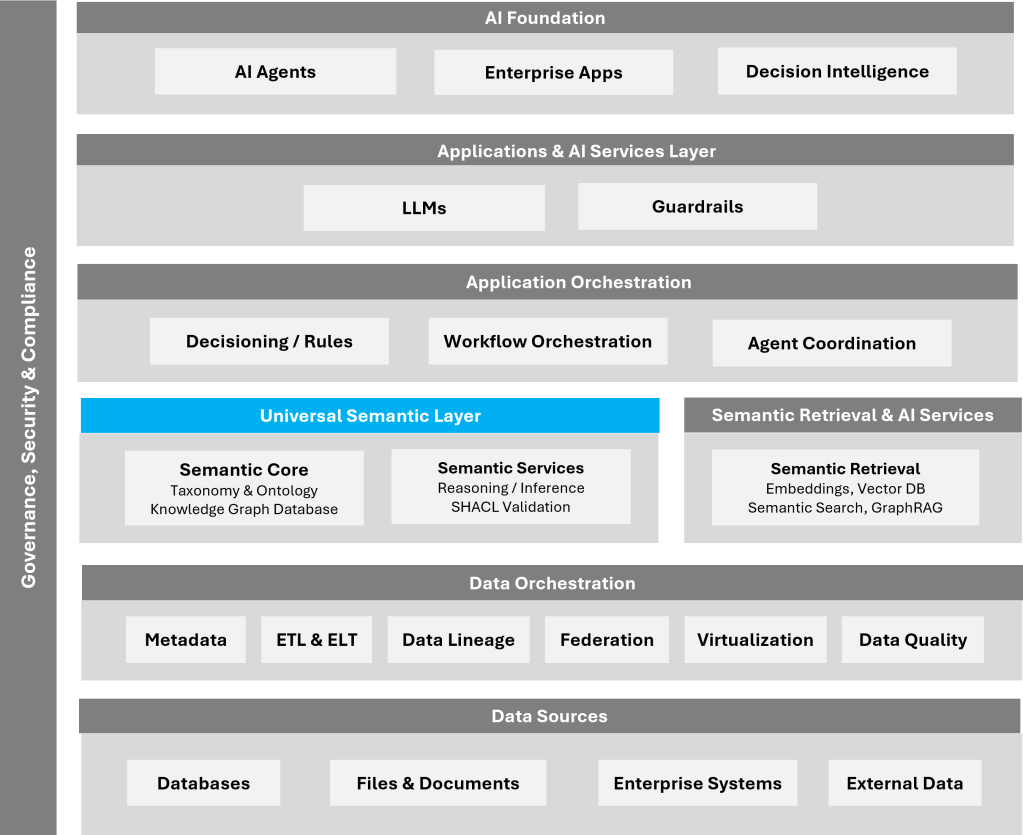
Architecture Layers Explained
Data Sources Layer
This layer comprises enterprise systems that provide the foundational inputs into the architecture.
Operational Inputs include operational systems, transactional systems, and customer & engagement systems, representing the core business data generated across the enterprise.
Compliance & Enterprise Inputs include risk & compliance systems, enterprise systems (ERP, HR), document & content repositories, and external data providers, ensuring that regulatory, structured, and unstructured data sources are fully integrated into the architecture.
Data Orchestration Layer
This layer manages how data is ingested, processed, and prepared for downstream use.
Data Handling includes data ingestion (batch & streaming) and ETL & ELT processing, ensuring that data is efficiently collected and transformed across systems.
Data Virtualization & Federation enables integration across distributed environments without unnecessary replication, supported by data quality validation and metadata capture to ensure consistency, accessibility, and governance.
Universal Semantic Layer
At the core of the architecture, the Universal Semantic Layer defines business meaning, relationships, and context across the enterprise—establishing a governed foundation for contextual intelligence and knowledge representation.
The semantic core building block includes taxonomy and ontology management together with the knowledge graph, establishing a structured and governed representation of enterprise knowledge.
It defines canonical entities, relationships, and semantic rules—enabling consistent interpretation of data across systems and supporting reasoning, inference, validation, and interoperability.
Semantic Retrieval & AI Services
This layer provides embeddings, Vector DB capabilities, and hybrid search, enabling semantic retrieval across structured and unstructured data.
It supports GraphRAG and ensures scalable, high-performance access to enterprise knowledge grounded in governed semantic context.
Application Orchestration Layer
This layer coordinates how systems interact and how business processes are executed across the enterprise.
Process Automation includes API gateway, workflow & event processing, and BPM orchestration, ensuring that processes are executed consistently and efficiently.
Coordination includes event streaming & messaging, microservices & agent coordination, and decisioning & rules services, enabling real-time interaction, orchestration, and decision execution across systems.
AI Foundation
This layer provides the capabilities required to operationalize AI in a controlled and enterprise-ready manner.
Models & Runtime include foundation models (LLM, SLM), embedding & reranking models, and model serving & inference runtime.
Orchestration & Safety include prompt management & orchestration, guardrails & safety controls, and model governance & observability, ensuring controlled, explainable, and auditable AI execution.
This layer operationalizes GraphRAG by combining structured semantic context from the knowledge graph with relevance-ranked retrieval.
AI operates on governed semantic context, enriched through retrieval, rather than isolated data inputs.
Applications & AI Services Layer
Business Applications include digital experience, customer management, enterprise content & document applications, and enterprise productivity solutions.
Decisioning Applications include operations & case management, risk & compliance, and decisioning & intelligence applications, enabling consistent, explainable, and governed decision-making across the enterprise.
At the top of the architecture, applications and AI services consume governed semantic context to deliver business outcomes.
Governance, Security & Compliancer
Spanning all layers of the architecture, governance, security, and compliance provide continuous control and assurance.
Policy & Control includes compliance policy, identity & access control, and policy, model risk & AI governance, ensuring that rules, access, and regulatory requirements are consistently enforced across the enterprise.
Monitoring & Traceability includes data lineage, audit, monitoring & explainability, ensuring that all data, processes, and AI-driven decisions remain transparent, traceable, and audit-ready.
This cross-layer capability ensures continuous control, auditability, and alignment with regulatory expectations by design..

